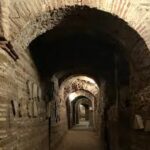
- The Roman Catacombs have remained a subject of misconception for centuries, as portrayed by filmmakers and novelists. Henry Sienkiewicz’s novel, Quo Vadis (1896), which was adapted into the 1951 movie by the same title and directed by Mervyn LeRoy, is notable for its historical misrepresentation of the role of the Roman catacombs in the first and second centuries of Christianity in Rome, especially during the persecution of Christians under Emperor Nero. While both the book and movie were based on an actual historical setting, they developed through some fictional characters and historical inaccuracies, including an exaggerated presentation of the persecution of Christians. At the same time, the catacombs were erroneously presented as a hideout for persecuted Christians, a secret worship of early Christians and a dungeon of fear and prisons of despair. These literary works, among others, may have also fuelled the misconception that early Christians created the catacombs in secrecy and held regular church worship and a place of hideouts or served as a place of punishments. These popular culture and non-historical narratives have obscured the profound significance of the catacombs, their historical context and how they have helped in the development of some Christian doctrines or served as testimonies of hope, especially in the resurrection.
- The Roman catacombs are ancient subterranean burial places where early Christians were buried in Rome (The Catholic Encyclopedia, “The Roman Catacombs”). They are underground burial sites with stairways and are located outside the city walls of Rome. The Roman catacombs were generally situated outside the city wall, according to the prescription by the First Code of the Roman Law, the Lex XII Tabularum (Laws of the Twelve Tables). It states that “A dead person shall not be buried or burned in the city” (Cf. The Twelve Tables, the original Roman common law, transcribed by Leo, Table X. “Sacred Law”, p 18). Burials took place outside the sacred precincts of the City of Rome, the Pomerium, so as to prevent disease and maintain civic purity. This led to the development of necropoles (cemeteries) outside the city walls for burials. These burial places were originally called koimeterion, coemeterium, meaning “place of rest.” Therefore, the burial grounds were not located outside the city walls because Christians owned them, but rather because this was the Roman rule, even before the rise of Christianity.
- The catacombs in Rome originated around the end of the first century and the beginning of the second century A.D. under the papacy of Pope Zephyrinus, who entrusted to deacon Callixtus the task of constructing a cemetery in the Appian Way (The Christian Catacombs”, https://www.vatican.va/roman_curia/pontifical_commissions/archeo/inglese/documents/rc_com_archeo_doc_20011010_cataccrist_en.html#Origini). That catacomb would later be known as the Catacomb of St. Callixtus. Before Christians started constructing catacombs in Rome, there were already Jewish catacombs. Initially, Romans preferred cremation to inhumation as a burial option before the 1st century AD due to sanitary and religious reasons. It was generally believed that fire had a purificatory quality that would cleanse the deceased and pass it properly into the afterlife, and this was thought to separate the soul from the body symbolically. Hence, the preference for cremation. In contrast, the Jews privileged inhumation due to their religious beliefs and reverence for the body. This belief is rooted in the Old Testament scriptures and faith in the resurrection of the dead. Hence, the Jews in Rome forbade burials by cremation and observed burial by inhumation for their dead, and this led to the construction of catacombs to continually preserve their Jewish identity and the perpetuation of their religious culture.
- The Roman Catacombs were imitations of the Jewish catacombs and a reflection of the Christian belief in the resurrection of the dead, which is a central belief in Christianity. As Christianity gained expansion and organisation in the 3rd century, catacombs became organised burial grounds overseen by the Church, especially with the construction of the Catacomb of Callixtus, which served as a burial place for some popes and martyrs. While converts from Judaism to Christianity were buried in the Jewish catacombs, heathens who converted to Christianity needed a place to be buried, and this inspired the construction of the Christian or Roman catacombs. At the beginning of the third century, Emperor Constantine and Emperor Licinius issued the Edict of Milan (313 AD), which granted freedom of worship and toleration to the Christian religion. As a consequence of this, the catacombs flourished not just as places of burial for Christians but also as places of pilgrimage for the early martyrs who were buried there. Furthermore, the graves of venerated martyrs also served as a nucleus for the catacombs. Some also originated as private family burial vaults, which were later expanded. So such catacombs took the names of their founder, like the Catacomb of Domitila, which was developed on land belonging to Flavia Domitilla, a member of the imperial family. The catacombs, as underground cemeteries, fostered an idea of the community of the dead, especially for those who profess faith in the resurrection. The estimated number of graves in the Roman catacombs was over 2 million. (Cf. Catholic Encyclopedia, Ibid.). Some of the earliest catacombs from the Apostolic era include the Catacomb of Domitilla, the Catacomb of Priscilla, the Catacomb of Callixtus, the Catacomb of Lucina and the Catacomb of Commodilla. The Catacombs declined by the 5th Century onwards, with Christianity now fully public and churches being built above ground.
- The catacombs were not just places of gloom, sorrow or despair, but of hope. The inscriptions and symbols found in the Roman catacombs speak of the witness of hope amongst the early Christians as well as their faith expressions. The tombs were characterised by great simplicity, with some featuring only simple epitaphs, symbols, or augural prayers. Pope Francis coheres that: “In the catacombs, everything speaks of hope, everything: it speaks of life beyond death, liberation from danger and from death itself through the work of God, who in Christ, the Good Shepherd….” (Address of the Holy Father, Pope Francis with participants in the Plenary Meeting of the Pontifical Commission for Sacred Archaeology, 17th May, 2024). The early Christians frequently expressed their hope in augural words and prayers with tomb epitaphs such as: “vivas in pace”, “Vivas in Deo”, “Vivas in Christo”. The catacombs were also adorned with frescoes, mosaics and sculptures, which were further expressions of faith and hope. Some of these were New Testament scenes, such as Jonah and the Fish, and Christ the Good Shepherd. Some of the symbols of tombstones include the anchor which expresses the steadfastness and security of faith and hope; the fish identified with Christ which alludes to the sacrament of baptism by which we gain salvation; the ship which expresses steadfastness of faith in Christ; the Alpha and Omega symbols meaning Christ as the beginning and the end (Rev. 22:13), the symbol of doves and olive branches which symbolized peace and eternal rest; the symbol of wreath which was a symbol of victory of eternal life and also the Chi-Rho monogram which was a symbol of victory and resurrection. The Chi-Rho symbol, which is one of the oldest in Christianity, gained wider fame after Emperor Constantine reportedly had a vision of the symbol before the Battle of the Milvian Bridge (312AD) with the words: “By this sign, you shall conquer”. After his victory, the Chi-Rho symbol was popular for triumph, and in the catacombs, the symbol was already used even before Emperor Constantine’s vision for victory over the grave. The catacombs serve as a testament to the witness of hope from the early Christians.